
The most effective way to cut AI coding token burn is not simply adding a vector database, but pairing repository-appropriate retrieval with strict prompt-cache prefix engineering [1]. Most coding agents bleed tokens in two places: multi-turn exploratory grep and full-file reads that bloat context, and cold prompts after session resets, timeouts, or configuration changes that miss the KV cache and trigger 1.25x to 2.5x cache-write charges instead of 90% to 98% read discounts on current frontier models [3]. Consequently, shrinking what sits in a cold-start prefix, by keeping CLAUDE.md lean, pruning unused MCP schemas, and resetting sessions cleanly via structured markdown handoffs, often saves more money and preserves higher reasoning quality than heavy indexing infrastructure alone [3].
Across the indexing landscape, SocratiCode provides one of the fullest local-first Model Context Protocol (MCP) engines, combining Qdrant dense vectors, BM25 lexical fusion, 18-language AST dependency graphs, and blast-radius analysis; its vendor benchmarks on VS Code's 2.45M-line repository claim 61% to 61.5% less context consumed and 84% fewer tool calls than grep [4]. However, those savings figures trace solely to SocratiCode's own marketing materials with no independent third-party verification found in available sources, and exposing its 15+ MCP tools permanently enlarges the cached prefix on small projects [4]. Among major platforms, Cursor, Windsurf, Augment Code, and Sourcegraph Cody bypass local Docker setups via Merkle-synced cloud embeddings, specialized SWE-grep subagents, or enterprise multi-repo indexes, whereas Claude Code, Aider, and minor open-source utilities (CocoIndex Code, Serena, Repomix, RepoMapper, jCodeMunch, Ripwire) favor zero-index lexical search, Tree-sitter PageRank maps, or surgical AST symbol lookup [3].
In practice, experienced practitioners across developer forums and engineering blogs treat harness discipline as their primary cost lever. Rather than letting conversations fill to 97% auto-compaction, which produces degraded summaries and expensive cache rebuilds, power users manually run /handoff and /clear at 40% to 60% window capacity, filter noisy test and lint output through concise CLI wrappers, audit /mcp to drop idle servers, delegate codebase exploration to isolated cheap subagents, and monitor cache_read_input_tokens directly via /usage or transcript scripts [1]. (For our practical breakdown of these tools, see Codebase Indexing Today: Every Major Tool and Its Caveats.)
Why Cold Prompts After a Reset Miss Cache and Inflate Costs
Major LLM APIs implement prompt caching via exact prefix hashing over prefilled key-value (KV) attention tensors [1]. Requests serialize in a rigid hierarchy: tool definitions first, then system instructions, then conversation messages. A single byte difference anywhere upstream invalidates the cached hash for that block and every token downstream [13]. When a session resets, times out, or changes a prefix byte, the next message becomes a cold prompt: not only do you lose the cached read rate, you often pay a 25% to 150% cache-write premium on the entire rebuilt context [5].
| Provider and Model Tier (Oct to Nov 2026) | Minimum Prefix | Default and Extended TTL | Write Multiplier (vs. Base Input) | Cache Read Rate (vs. Base Input) | Key Reset and Routing Traps |
|---|---|---|---|---|---|
| Anthropic Claude Sonnet 5.5 / Opus 5.5 | 512 tokens [6] | 5m (API/subagents) or 1h (Pro/Max main thread) [5] | 1.25x (5m) / 2.0x (1h) [5] | 0.05x ($0.10 / $0.20 per MTok) [5] | TTL clock starts at request start, not response end; a 4-min turn leaves ~1 min [30]. |
| Anthropic Claude Haiku 5.5 | 512 tokens [6] | 5m default / 1h optional [5] | 1.25x (5m) / 2.0x (1h) [5] | 0.10x ($0.01 up to 100K; $0.05 over 100K) [5] | Crossing 100K total tokens raises all rates 5x, even for cached tokens [5]. |
| Anthropic Claude 4.5 to 4.8 / Sonnet 5 | 1,024 to 4,096 tokens (by model) [30] | 5m default / 1h optional [5] | 1.25x (5m) / 2.0x (1h) [5] | 0.10x (0.025x on Fable/Mythos 5.1) [5] | Bedrock lists 4,096 min for Opus 4.7 vs. Anthropic's 2,048; short prompts skip quietly [30]. |
| OpenAI GPT-5.6+ / GPT-6.1 Sol / Astra / Luna | 1,024 visible tokens [6] | 30m default / 12h (Responses API, Oct 2026) [6] | 1.25x (30m) / 2.5x (12h) [6] | 0.10x (0.05x on GPT-6.1 Sol) [6] | Upgrading 30m to 12h charges a fresh write; >15 req/min can overflow cache nodes [7]. |
| OpenAI Pre-5.6 (GPT-5.5, GPT-4o, o1) | 1,024 tokens [24] | 5 to 10m in-memory (up to 1 to 24h off-peak) [24] | None (1.0x) [6] | 0.50x (standard legacy tiers) [33] | Matches step in 128-token blocks; Azure Foundry clears within 24h [24]. |
| Google Gemini 4 Argon / 3.8 Flash / 3.1 Pro | 2,048 to 4,096 tokens [6] | Implicit (unstated) or explicit 1h default [24] | None listed; explicit caches bill hourly storage [24] | 0.05x (Argon) / 0.10x (3.8 Flash, 3.1 Pro) [6] | Explicit storage costs $0.50 to $4.50 per MTok/hr; Argon is implicit-only [24]. |
DeepSeek deepseek-flash (V4.1-Flash) | Prefix units [24] | Automatic disk cache, hours to days [24] | None (1.0x) [6] | 0.02x ($0.006 peak / $0.003 off-peak) [6] | Best-effort persistence; peak rates apply 01:00 to 04:00 & 06:00 to 10:00 UTC Mon to Fri [6]. |
Because short-TTL writes cost 25% extra and extended-TTL writes cost 100% to 150% extra, caching loses money whenever a prefix expires before generating enough hits [7]. Using Anthropic and OpenAI multipliers, a 5-minute or 30-minute write (1.25x write, 0.10x read) totals 1.35x across two calls versus 2.00x uncached, breaking even on the second request (one cache hit) [30]. By contrast, Anthropic's 1-hour write (2.0x) and OpenAI's 12-hour write (2.5x) lose money on a single hit (2.10x or 2.60x vs. 2.00x uncached) and require two hits (the third request) to turn profitable (2.20x or 2.70x vs. 3.00x uncached) [7]. For short static prompts below the minimum token floor, OpenAI's prompt-caching guide provides the break-even padding formula L = M * [r + (w - r) / N], where M is the minimum length, r is the read rate, w is the write rate, and N is request count; with M = 1,024, r = 0.10, and w = 1.25, L = 102.4 + 1,177.6 / N, meaning over 10 calls, padding any prefix of 221 tokens or more to 1,024 saves money [24].
An illustrative calculation on Claude Sonnet 5.5 ($2.00/MTok base input, $2.50/MTok 5-minute write, $4.00/MTok 1-hour write, $0.10/MTok read) shows why resetting cleanly matters more than caching alone [5]. Suppose you resume a bloated 150,000-token API conversation three times after 10-minute breaks: because each gap exceeds the 5-minute API TTL, every resumption triggers a full 150,000-token cold write (0.15 * $2.50 = $0.375), totaling $1.125 across the three resumptions, 25% more expensive than turning caching off completely (3 * 0.15 * $2.00 = $0.900) [5]. Switching that same 150,000-token thread to the 1-hour TTL cuts the three resumptions to one write plus two reads (0.15 * $4.00 + 2 * 0.15 * $0.10 = $0.630), saving 44% against the 5-minute misses [5]. Better still, if you summarize state into a markdown handoff, run /clear, and use targeted code indexing to keep your clean-reset prefix around an illustrative 15,000 tokens (for example, a 300 to 600-token CLAUDE.md, handoff summary, slim tools, and retrieved code chunks), each cold start costs just $0.0375 (0.015 * $2.50), $0.1125 across three cold starts (a 90% reduction), while subsequent warm turns inside each burst cost $0.0015 per read [3].
Even attentive developers hit subtle cold-prompt traps that silently re-trigger full writes:
- Late compaction and TTL mismatches: Running
/compactrewrites history by design; doing so after an idle gap when the 5-minute cache has expired forces a full cold write just to read and summarize stale history, whereas/cleardrops it cleanly [13]. Furthermore, while an independent analysis of 63,880 billed Claude Code requests (July to August 2026) confirmed that Claude Pro/Max subscriptions within plan limits default the main conversation to a 1-hour TTL, API keys, Bedrock/Vertex setups, over-limit usage credits, and all subagents default to 5 minutes unless overridden viapromptCacheTtlorENABLE_PROMPT_CACHING_1H=1[28]. - Turn duration eating TTL: Cache lifetime counts from when a request starts, not when streaming finishes, so a 4-minute agent turn leaves roughly 60 seconds for your follow-up before a 5-minute entry expires [30].
- Mid-session setting and tool mutations: Each model maintains an independent KV cache, and
/effort, fast-mode flags, client upgrades, or dynamic MCP tool registrations change the prefix key, meaning switching from Opus to Haiku 100K tokens into a session forces Haiku to pay a cold write from scratch [1]. - Worktree splits, fan-out races, and silent underflows: Claude Code binds its cache key to the working directory and startup git status, so parallel agents in separate git worktree folders split and re-write project context; launching identical agents simultaneously forces every one to cold-write because a cache entry is unreadable until the first response begins streaming; and any prefix shorter than a model's 512 to 4,096-token floor reports
cache_creation_input_tokens: 0with no warning error [5].
Choosing the Best Codebase Indexing Architecture for Your Repo
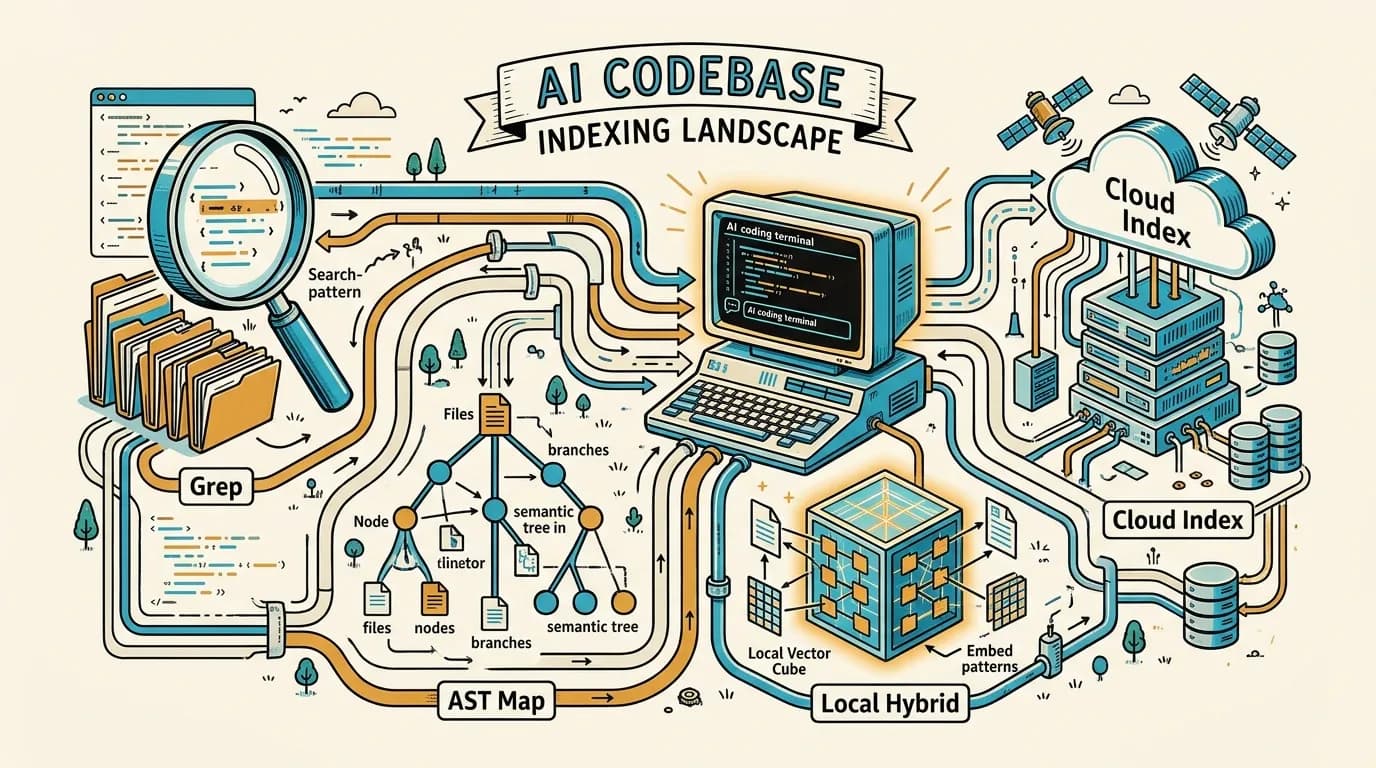
Codebase indexing saves tokens when it replaces multi-step file discovery (repeated keyword guesses followed by reading entire 400-line files) with single-call retrieval of exact symbols, signatures, or dependency slices [3]. In 2026, tools split into four architectures, and choosing the wrong layer either wastes setup effort or bloats your prompt prefix with unnecessary MCP tool definitions [2].
The minimalist baseline is no-index agentic retrieval, used natively by Claude Code and Codex CLI [2]. Giving a strong model ripgrep and glob alongside a compact CLAUDE.md or curated llms.txt directory eliminates index staleness, local vector databases, and extra MCP schemas [2]. It consistently excels on small or well-organized repositories where exact identifiers are predictable, though unfamiliar legacy systems without clear naming conventions force iterative search loops that consume excess turns and tokens [4].
The middle ground is deterministic AST and graph mapping, pioneered by Aider's Repo Map [37]. By parsing files via Tree-sitter .scm queries into a directed reference graph and running Personalized PageRank biased toward active files, this pattern binary-searches scope-elided class and function signatures (replacing implementation bodies) to fit a strict token budget (often ~1,000 to 2,048 tokens) [21]. It captures architectural hubs without embeddings or vector storage, though surface-level name matching collides when distinct modules reuse names like fetchRequest and lacks conceptual synonym search [37].
For large polyglot repositories, AST chunking paired with hybrid vector/BM25 search and call graphs (used by SocratiCode, CocoIndex Code, Cursor, and Sourcegraph Cody) embeds syntactic functions and classes rather than arbitrary text slices and combines semantic similarity with exact lexical matching [3]. Finally, specialized search subagents and compiler-grade indexes, such as Windsurf's SWE-grep Fast Context subagent, Claude Code's isolated Haiku Explore subagents, Ripwire, and ArgosBrain's SCIP/LSP graphs, offload noisy discovery out of the main reasoning window or resolve true cross-file types statically [1].
| Codebase and Workflow Profile | Best-Fit Indexing Strategy | Recommended Tooling Examples | Why It Maximizes Net Token Savings |
|---|---|---|---|
Small/medium repo (<50K LOC) with clear naming | No index; lexical ripgrep + slim CLAUDE.md / llms.txt | Native Claude Code or Codex CLI [2] | Zero MCP tool-schema tax on cold prompts; zero index staleness [2]. |
| Moderate repo needing architectural orientation | Stateless or cached AST + PageRank signature map | Aider RepoMap, RepoMapper, jCodeMunch, Repomix [20] | Packs high-centrality signatures into a strict ~1K to 2K token budget without file bodies [21]. |
Large single/multi-repo (>100K LOC), strict privacy/air-gap | Local AST hybrid vector/BM25 + dependency graph or CLI chunker | SocratiCode (Docker/native Ollama), CocoIndex Code (ccc), Ripwire [3] | Cuts multi-turn grep loops and blast-radius guesswork locally with zero code egress [3]. |
| Large commercial/enterprise repo (cloud acceptable) | Managed real-time cloud index or SWE-grep IDE harness | Cursor, Windsurf Fast Context, Augment Code, Sourcegraph Cody [17] | Sub-second incremental Merkle/real-time updates and cross-repo awareness without local GPU/RAM load [18]. |
| Automated bulk ingestion / entity extraction pipelines | Static-first prompt templating over automatic API cache | LightRAG-style split (system instructions vs. user chunk) [45] | Reuses static instruction prefixes across thousands of chunks for 45% to 90% input savings [45]. |
SocratiCode Evaluated: Capabilities, Vendor Claims, and Real-World Limits
SocratiCode (v1.8.3, AGPL-3.0 open-source engine by Giancarlo Erra and Altaire Limited, alongside a private-beta socraticode.cloud enterprise service) targets teams wanting full semantic search, call graphs, and infrastructure awareness locally with minimal configuration [4]. Adding npx -y --prefer-online socraticode@latest to an MCP client, or installing its VS Code/Open VSX extension or Claude plugin, automatically provisions local Docker containers running Qdrant and Ollama (nomic-embed-text) with zero YAML setup or external API keys [4].
Technologically, SocratiCode goes well beyond basic vector RAG. It segments files via AST-aware chunking and blends dense embeddings with BM25 lexical search through Reciprocal Rank Fusion (SEARCH_DEFAULT_LIMIT=10, SEARCH_MIN_SCORE=0.10), allowing conceptual questions and exact symbol lookups in one call [4]. Across 18+ languages, static AST analysis constructs file-level dependency graphs with circular-dependency detection and an interactive editor webview, symbol-level blast-radius impact analysis before edits, and forward call-flow tracing (codebase_flow) from auto-detected entry points [4]. It also indexes non-code context artifacts (database schemas, OpenAPI specs, architecture docs, and infra configs) and supports cross-repo linked workspaces, branch-aware project IDs, and checkpoint-resumable batched indexing across auto, manual, off, and git ref/HEAD watcher modes [11].
In its public benchmarks on VS Code's 2.45M-line repository using Claude Opus 4.6, SocratiCode reports 61% to 61.5% less context consumed (250KB down to 96KB), 84% fewer tool calls (31 steps down to 5), and 37x faster responses compared to grep-based exploration, alongside assertions of enterprise battle-testing past 40M lines and initial indexing of 3M+ lines in under 10 minutes on a MacBook Pro M4 [4]. Vendor documentation also argues that pre-computing dependency traversal and blast radius lets smaller, cheaper models handle architectural tasks that otherwise demand frontier models [44].
Two critical caveats temper those headline claims. First, no independent third-party benchmark comparing SocratiCode against agentic grep, Cursor, or lightweight AST tools was found; all circulating efficiency figures originate from SocratiCode's own website, repository, and MCP directory listings [4]. Second, SocratiCode carries real operational and cold-prompt trade-offs. Its own skill documentation notes that Docker cannot access host GPUs on macOS or Windows, making initial local indexing slow unless you install native Ollama for Metal/CUDA acceleration or configure cloud embeddings (OPENAI_API_KEY or GOOGLE_API_KEY) [11]. More importantly for cold-prompt budgets, SocratiCode exposes at least 15 MCP tools (codebase_index, codebase_search, codebase_update, codebase_status, codebase_graph_build, codebase_flow, codebase_context_index, and lifecycle utilities) [11]. Because every MCP tool definition sits at the front of the prompt prefix, loading SocratiCode adds static overhead to every cold write: worthwhile on sprawling multi-million-line repos where blind grep wastes dozens of turns, but counterproductive on small projects where native ripgrep finishes in two calls [1].
Major Players vs. Minor Players Across the Ecosystem
Commercial IDEs and enterprise platforms optimize for background freshness and cross-repo coordination, whereas minor open-source projects focus aggressively on small tool footprints, AST signature compression, or CLI-first access to protect the LLM's prefix budget [3].
| Platform or Tool | Category and License | Indexing Mechanism | Privacy and Hosting | Notable Strengths and Evidence Caveats |
|---|---|---|---|---|
| Cursor | Major AI IDE (Proprietary) | Syntax/AST chunking + Merkle tree sync + cloud vectors + local Instant Grep [18]. | Cloud (Turbopuffer); paths obfuscated, plaintext discarded [40]. | Searchable at 80% index progress; .cursorindexingignore granularity; requires internet (no air-gap) [40]. |
| Windsurf Fast Context | Major AI IDE (Proprietary) | Specialized SWE-grep and SWE-grep-mini retrieval subagents [17]. | Cloud/IDE-managed subagent [17]. | Vendor documentation claims up to 20x faster code retrieval; no independent benchmarks found [17]. |
| Augment Code | Major Enterprise Platform (Proprietary) | Proprietary real-time Context Engine tracking 400,000+ files on every keystroke [19]. | Cloud-only; SOC 2 Type II & ISO/IEC 42001 ($20/mo+ credits) [19]. | Vendor claims sub-200ms latency on 100M+ LOC, 70.6% SWE-bench, and multi-repo agents; no on-prem option [19]. |
| Sourcegraph Cody / Amp | Major Enterprise Platform (Proprietary / OSS ecosystem) | Cross-repository indexing and embeddings-based semantic graph [19]. | Cloud or self-hosted via Sourcegraph [19]. | Millisecond cross-repo exploration; a competitor comparison notes scheduled refresh and discovery focus [19]. |
| GitHub Copilot | Major IDE Extension (Proprietary) | Repository-level semantic code search index [51]. | Cloud-hosted via GitHub [51]. | Native repository integration; tightly coupled to GitHub/Copilot ecosystem [12]. |
| Claude Code & Codex CLI | Major CLI Agents (Anthropic / OpenAI) | No vector DB; iterative ripgrep/glob refinement + CLAUDE.md + Explore subagents [1]. | Local file traversal; cloud LLM inference [16]. | Zero index maintenance; Codex deterministically sorts tools and Claude locks them for cache hits [1]. |
| Aider | Major OSS CLI Agent (Apache 2.0 ecosystem) | Tree-sitter AST tags + Personalized PageRank + grep_ast scope elision [37]. | Local parsing with mtime disk cache; ~1K-token default map [41]. | Covers 26 to 33+ languages (up to 130 surface grammars cited); stateless across exits and collides on duplicate symbol names [41]. |
| SocratiCode | Minor/OSS MCP & Plugin (AGPL-3.0 / Cloud beta) | AST chunking + Qdrant/BM25 RRF + 18-lang dependency/call graphs [4]. | Local Docker (Qdrant/Ollama) default; optional cloud [11]. | Vendor claims 61% less context & 84% fewer calls; no third-party tests; 15+ MCP tools; macOS/Win Docker lacks GPU [4]. |
CocoIndex Code (ccc) | Minor OSS CLI + MCP (Apache 2.0) | AST-based semantic code search returning targeted chunks [3]. | Local embedding compute [3]. | Offers both a context-efficient ccc CLI and ccc mcp server to avoid whole-file reads [3]. |
| RepoMapper & jCodeMunch | Minor OSS MCPs (MIT / Open Source) | RepoMapper: Aider PageRank port (2 tools, 35 langs); jCodeMunch: persistent index + get_tectonic_map [21]. | Local MCP servers [21]. | jCodeMunch adds caller tracing and git co-churn signals; rival-page data notes RepoMapper had 217 stars and late-2025 last activity [21]. |
| Repomix | Minor OSS Packer / MCP | Tree-sitter signature compression stripping function bodies [20]. | Local CLI / MCP [20]. | Vendor docs report ~70% token reduction; static packing rather than live graph traversal [20]. |
Ripwire (redhat-et/ripwire) | Minor OSS CLI + MCP (C++23) | Zero-dependency static analysis computing blast radius and required tests [15]. | Local C++23 binary [15]. | Cuts token burn without reading full repos; newer niche ecosystem [15]. |
| ArgosBrain | Minor / Emerging Platform | Persistent compiler-grade SCIP, live LSP, and semantic-hook tree-sitter graph [42]. | Persistent local/hybrid graph [42]. | Resolves cross-file members/overrides and retains memory across quits (vendor claims vs. Aider) [42]. |
@code-indexer/mcp | Minor OSS MCP | OpenAI or Ollama (nomic-embed-text) embeddings + Milvus DB (3 tools) [54]. | Local or hosted Milvus/Ollama [54]. | Minimal 3-tool surface (index_codebase, search_code, clear_index) with auto-sync; vector-only [54]. |
Serena (oraios/serena) & Community Micro-Tools | Minor OSS / Community (rtk, distill, grepai, codebase-memory-mcp, SourcePrep) | Code-indexing MCPs and token-saving CLI utilities [53]. | Primarily local OSS [53]. | Frequently cited in r/ClaudeAI and YouTube token-saving guides; internal architectures and benchmarks lack detail in available sources [53]. |
Two clear divides separate major and minor tools. First, Cursor, Augment Code, and Windsurf trade local autonomy for seamless latency: Cursor's Merkle-tree sync and obfuscated Turbopuffer storage solve incremental freshness automatically, though enterprise teams in air-gapped environments cannot use it, and monorepo users often open specific package subfolders to keep indexing responsive [18]. Second, minor OSS developers increasingly mirror Unix design to protect prompt caches: CocoIndex Code (ccc), Ripwire, and RepoMapper minimize tool surface area (2 to 3 tools or a stateless CLI binary) rather than loading sprawling MCP schemas into every cold prompt [3]. Note that performance comparisons from Augment Code, Windsurf, Repomix, jCodeMunch, and ArgosBrain are all self-published by their respective vendors rather than independent benchmarks [17].
Self-Solutions and How Power Users Actually Save Tokens
Across Reddit (r/ClaudeAI), Hacker News, and developer engineering blogs, practitioners consistently emphasize that disciplined session and context hygiene saves more tokens than tweaking model hyperparameters [10]. Rather than letting one chat accumulate hundreds of thousands of tokens of trial-and-error logs, power users rely on three complementary habits.
First, handoff-driven resets replace late auto-compaction. Letting Claude Code auto-compact at 97% to 100% capacity turns ~200,000 tokens into a blurry ~1,000-token summary after context rot has already triggered bad edits, and repeating compactions acts like making a photocopy of a photocopy [8]. Instead, practitioners watch /context and intervene at 40% to 60% window consumption (roughly 100K on a 200K window, 300K to 400K on a 1M window, and strictly under 100K on Haiku 5.5 to avoid its 5x price tier jump) [6]. Using custom slash skills like /handoff (such as simplybychris/handoff-skill), they prompt the agent to write a structured markdown checkpoint (session-logs/YYYY-MM-DD-topic.md or .claude/session-handoff.md) listing the goal, edited files, architectural decisions, failing tests, exact next step, and dead ends not to repeat [8]. They then execute /clear for a zero-noise reset and resume via /pickup or prime, which one workflow demonstration reports cuts active window consumption from ~43% down to ~10% while keeping cold-write costs minimal and making work portable across tools like Claude and ChatGPT [8]. When stepping away for a break mid-task without resetting, another community habit is running /compact before leaving while the prompt cache is still warm, avoiding a cold re-read of stale history upon return [28].
Second, CLI noise filtering, MCP pruning, and prefix discipline keep contexts lean. Raw test logs, linter dumps, and git diff outputs are major context killers; engineers wrap them in custom shell scripts (cc-test, cc-lint, cc-typecheck, cc-log, cc-diff) that condense results to failure lines and counts before the LLM sees stdout [10]. Simultaneously, power users audit /mcp regularly to disable unused servers and favor CLI binaries (rg, ccc, ripwire) over always-on MCP schemas [3]. They keep root CLAUDE.md files strictly between 300 and 600 tokens, storing immutable stack rules while placing module rules in lazy-loaded subdirectory CLAUDE.md files; use Plan Mode (Shift+Tab) before writing code; use /rewind instead of arguing after a bad turn (reverting to an already-cached prefix); cap reasoning tokens (MAX_THINKING_TOKENS=0 or /effort) for trivial edits; and offload noisy search to isolated Haiku subagents [1]. Builders writing their own indexing pipelines apply identical prefix hygiene: in LightRAG GitHub Issue #2355, splitting static entity-extraction instructions (~1,300 tokens) into the system prompt and putting only the variable chunk (~150 tokens) into the user message cut prompt costs across 8,000 chunks by an estimated ~45% via OpenAI's automatic prefix cache while speeding ingestion 2 to 3x [45].
Third, DIY telemetry, alert hooks, and custom repo-map patches close feedback loops. Rather than guessing whether a session is hitting cache, developers inspect the Prompt cache (main) line in /usage (which from Claude Code v2.1.260 flags likely miss causes such as changed tool definitions), customize /statusline to show live context and limit bars, or run ccusage and jq scripts against local transcripts to verify cache_read_input_tokens versus cache_creation_input_tokens [22]. Automation-heavy users add claude-code-context-alert hooks that pause at a set context threshold to prompt for a handoff [61], tune /autocompact 600k on 1M-token models [59], or run 4-minute keep-alive pings in API pipelines holding large caches across 6 to 10 minute gaps [27]. On the indexing side, teams frustrated by Aider's stateless surface-name PageRank collisions have forked repomap.py to inject real language import resolvers (such as Meetsmore's PythonResolver and JS resolver), while minimalists skip indexing software altogether in favor of a hand-maintained llms.txt codebase map paired with ripgrep [2].
To put these practices into immediate action, apply this seven-step optimization sequence:
- Audit your active MCP servers and prefix: Run
/mcp(or check your agent config) and remove every server not needed for the current task, preferring CLI tools invoked on demand over persistent MCP schemas [3]. - Trim root instructions under 600 tokens: Strip volatile task notes out of root
CLAUDE.mdand move domain-specific rules into subdirectoryCLAUDE.mdfiles that load only when touched [9]. - Wrap verbose shell commands: Route tests, typechecks, linters, and logs through concise CLI wrapper scripts so stack traces do not flood the cached history [10].
- Align cache TTL with your break cadence: Keep 5-minute or 30-minute defaults for continuous sub-5-minute bursts, but enable Anthropic 1-hour (
promptCacheTtl) or OpenAI Responses 12-hour TTLs when natural coding pauses exceed 5 to 30 minutes and you make at least two follow-up calls [7]. - Protect prefix immutability mid-session: Avoid swapping models, changing
/effortor fast mode, toggling MCP tools, or running parallel agents across un-staggered worktrees mid-task; use/rewindto undo bad turns on a warm prefix [1]. - Reset via
/handoff+/clearat 50% capacity: Monitor/context, save a concise markdown handoff note (including dead ends) before hitting 50% to 60% usage (and below 100K on Haiku 5.5),/clearthe window, and resume clean [6]. - Layer indexing strictly to match repo friction: Rely on native
ripgrep+llms.txton repos under ~50K lines; adoptccc, Aider/RepoMapper, or jCodeMunch when architectural navigation slows down; and deploy SocratiCode (with native Ollama on macOS/Windows) or enterprise cloud context engines when multi-million-line scale and cross-module call graphs justify their setup and prefix footprint [2].
References
This report was compiled and synthesized with AI deep research from the sources listed below. We aim to trace figures to primary documentation rather than secondary commentary, though we do not independently benchmark or validate third-party or vendor-reported claims. Responsibility for the accuracy of any cited figure remains with the original source. Last compiled: November 2026.
- How Prompt Caching Actually Works in Claude Code
- From Claude Code to Agentic RAG - Notion
- How do I cut the tokens my coding agent burns per turn? - CocoIndex
- SocratiCode: Enterprise Codebase Intelligence for AI
- Prompt caching - Claude Platform Docs
- Prompt Caching Cost (Oct 2026): OpenAI, Claude, Gemini - Codersera
- OpenAI Prompt Caching Pricing: 12-Hour Cache Writes Cost 2.5x
- Claude Code skill: /handoff + /pickup - GitHub
- 10 Tips to Stop Burning Your Tokens in Claude Code - Medium
- 9 Ways to Cut Token Consumption in Claude Code - Composio
- SocratiCode codebase-management SKILL.md - GitHub
- SocratiCode - Open VSX Registry
- Anthropic Claude Prompt Caching: Pricing, 5-Min vs 1-Hour TTL
- Socraticode MCP Server: Tools, Setup & Config
- GitHub - redhat-et/ripwire
- An Exploratory Study of Code Retrieval Techniques in Coding Agents
- Fast Context - Windsurf Docs
- How Cursor Actually Indexes Your Codebase - Towards Data Science
- Augment Code vs Sourcegraph Cody: Enterprise Comparison
- MCP Server - Repomix
- jCodeMunch vs RepoMapper: how they differ and when to use each
- Claude Code Prompt Cache: Read the Hit Ratio, Set 5m or 1h TTLs
- How to Stop Burning Through Claude Code Tokens - MindStudio
- Prompt Caching Across AI Providers: Prices, TTLs and Setup
- Prompt Caching in LLMs and Azure AI Foundry - Medium
- MCP Tool List Prompt Cache: Stop the Cache Misses - Viral Ruparel
- Claude Prompt Caching in 2026: The 5-Minute TTL Change
- How prompt caching works in Claude Code - Reddit
- Claude Code Prompt Caching: The One Rule Behind It - PrimeLine
- Anthropic Claude prompt caching pricing: write, read, TTL math
- Anthropic Prompt Caching Pricing: The Full 2026 Breakdown
- Prompt caching - OpenAI API
- Prompt Caching in the API - OpenAI
- Prompt Caching: Cost & Performance Analysis Across Providers
- Claude Code Prompt Caching - Build This Now
- Do Parallel Claude Code Sessions Share a Prompt Cache? - Dev.to
- Repository Map Pattern: AST + PageRank for Dynamic Code Context
- Code Isn't Memory: A Structural Codebase Index - arXiv
- Grep or Embeddings? Agentic Search Over Company Documents - YouTube
- Cursor Codebase Indexing: How the AI Understands Your Repository
- PageRank Repo Map - GitHub NousResearch/hermes-agent
- ArgosBrain vs Aider
- Improving aider's repo map - Meetsmore Engineering
- GitHub - giancarloerra/SocratiCode
- Optimize for OpenAI Prompt Caching - LightRAG Issue #2355
- SocratiCode - Cursor Directory
- cursor-codebase-indexing - LobeHub
- Fastest AI Code Agent by Cognition (Windsurf AI) - YouTube
- AI Developer Tools: The 2026 Guide to AI Coding Tools - Sourcegraph
- awesome-ai-coding-tools - GitHub
- Indexing repositories for GitHub Copilot
- Prompt Caching in Coding Agents - Maximem
- Token-saving coding tools from Reddit
- @code-indexer/mcp - npm
- Meet Serena - YouTube
- Serena MCP + ccusage - YouTube
- How do you guys save tokens with Claude Code? - Reddit
- Maximizing the value of your Claude Code sessions - Hacker News
- Claude Code Context Window: Usage, Costs, and Tips - TinyFish Blog
- Claude Code: Save tokens with handoff, /clear and prime - YouTube
- Claude Code Context Alert: Handoff Before You Compact
Insights, Playbooks, Tips & Kits
Want real patterns from my journey building and selling SaaS & apps. DIY playbooks, code-ready starter kits, and the operational moves that let you scale without the overhead. For builders who learn best from firsthand mistakes, real wins & experience.