
There is a moment in every SaaS product where a traditional four-step onboarding wizard quietly kills your conversion rate.
I hit that exact wall this week while building the onboarding flow for Live QR Menu, my new digital menu platform for restaurants and cafes.
The goal is simple on paper: let any restaurant owner set up their business profile and publish a live digital menu in minutes, in whatever language they are comfortable using.
A clean UI stepper looks great in a Figma file. Step 1: business name and currency. Step 2: opening hours. Step 3: categories. Step 4: upload menu items.
In reality, a busy cafe owner does not think in a neat linear form. They want to drop a photo of a printed menu, type a few corrections in Urdu, Arabic, Spanish, or English, mention that they are closed on Tuesdays, and get back to their kitchen.
So instead of building another polished stepper, I decided to build a real AI onboarding agent. And that immediately dragged me into one of the hardest architectural debates in AI engineering: how do you keep an autonomous agent locked inside onboarding without turning it into a rigid state machine?
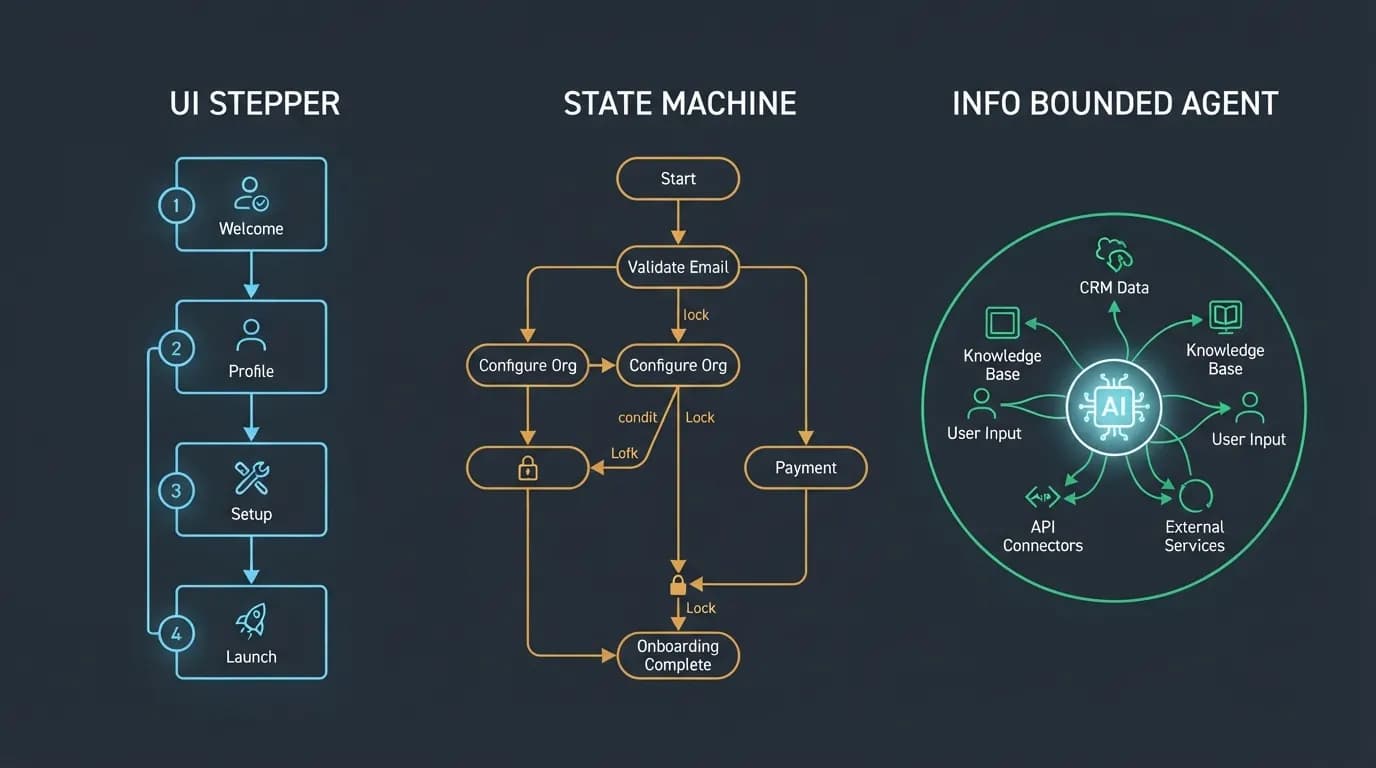
I have been testing this in beta for the past week. Here is the architecture battle between traditional steppers, LangGraph state machines, and my current approach: bounding the AI by information, not actions.
The Three-Way War: Stepper vs. LangGraph vs. Information-Bounded Agents
When you design an AI onboarding agent, you quickly run into three competing philosophies. Each one trades off user flexibility against engineering predictability.
| Architectural Approach | How Flow Is Controlled | Best Strength | Biggest Failure Mode |
|---|---|---|---|
| 1. Traditional UI Stepper | Hardcoded screens (Step 1, 2, 3, 4) | 100 percent predictable UI and validation | High drop-off on messy, non-linear, or multilingual inputs |
| 2. Deterministic Graph (LangGraph) | Explicit nodes, edges, and enum transitions | Prevents off-topic drift and enforces sequence | Rebuilds a rigid stepper inside code; breaks when users jump ahead |
| 3. Information-Bounded Agent | Full action freedom guided by live state context | Adapts to any language, order, or input format naturally | Requires strict state injection and backend tool validation to stay on track |
1. Why the Classic Stepper Fails Multilingual Restaurants
A stepper assumes every user arrives with clean, structured data in the exact order your database expects.
If you are building a digital menu tool for local restaurants globally, that assumption collapses immediately. Some owners have a PDF. Others have a WhatsApp text list. Others only want to type in their native language and let the system translate or structure categories automatically.
Forcing that workflow through sequential form screens creates unnecessary friction before the user ever sees value.
2. Why I Avoided a Deterministic Agent with LangGraph
Normally, when engineers want reliability in an onboarding agent, they reach for a deterministic framework like LangGraph or an explicit finite state machine.
As Google's Agent Development Kit team notes, defining an explicit state schema prevents an agent from skipping steps or hallucinating progress. That works brilliantly for long-running enterprise pipelines like two-week HR approvals or compliance audits.
But for a three-minute interactive restaurant setup, I found a frustrating paradox: wiring strict graph nodes and conditional edges just rebuilds a UI stepper in Python or TypeScript.
The moment a user says "Here is my menu photo, oh and our currency is PKR, and we open at 11 AM," a strict node-by-node graph either forces them to wait until the "hours" node or requires complex edge routing for every possible user shortcut. As one LangGraph architecture analysis points out, controlled workflows are orchestrated paths, not truly autonomous problem solvers.
I wanted the model to actually use its intelligence, not act as a glorified voice skin over a four-step form.
Bound by Information, Not Actions: My Beta MCP Approach
Instead of restricting which action the agent can take next, I flipped the constraint: give the agent freedom over actions, and bound it strictly by information.
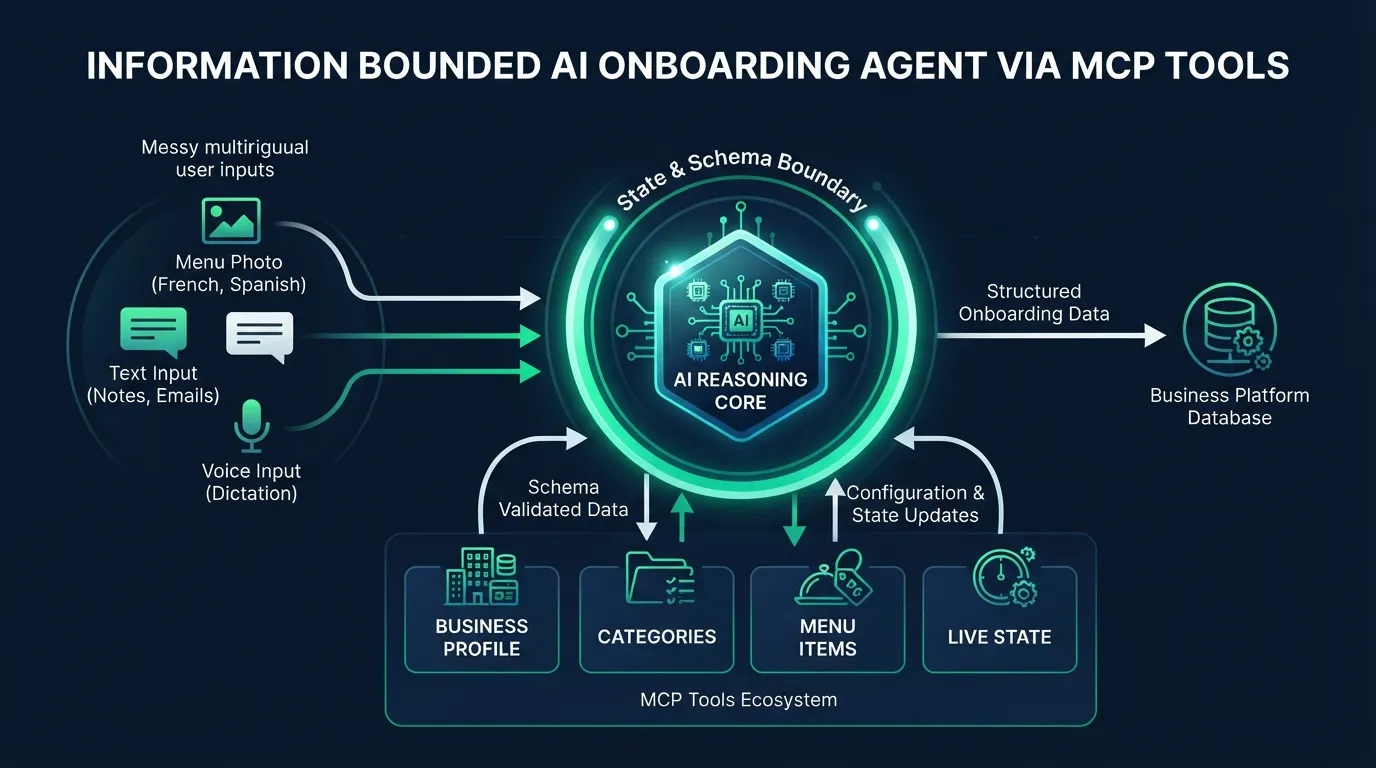
Here is how the beta architecture works right now in my testing:
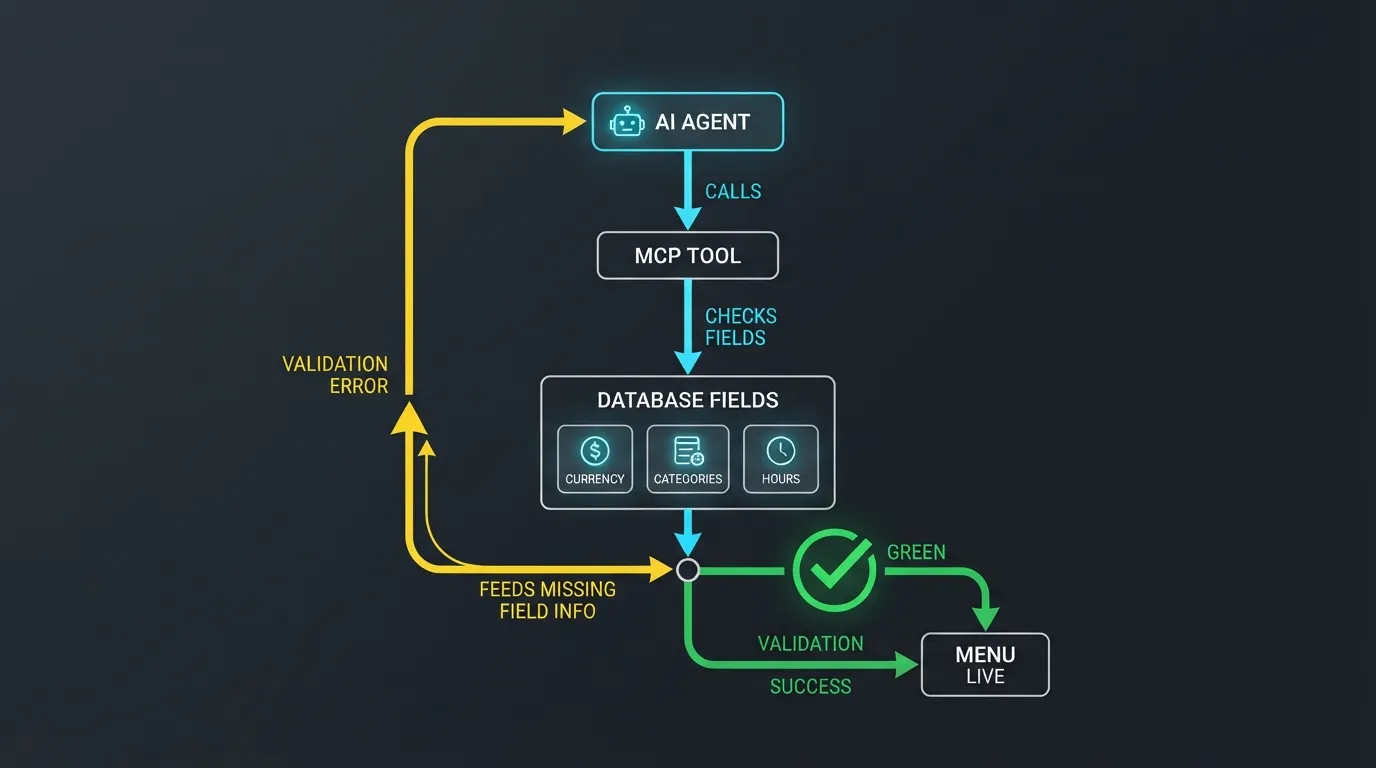
- An Onboarding MCP Tool Group: I exposed a dedicated Model Context Protocol (MCP) tool group specifically for onboarding. It includes tools to inspect the current restaurant profile, save business details, create menu categories, and batch-upsert menu items.
- Continuous State Awareness: On every turn, the agent does not have to guess where we are from raw chat history. The onboarding toolset gives it a structured snapshot of the current database state: what is already configured, what is still missing, and what validation rules apply.
- Zero Action Sequencing Rules: There are no hardcoded transitions saying "you must call
save_businessbeforeadd_menu_items." If the user pastes their entire menu in message one, the agent can parse it in whatever language the model supports, create the categories, save the items, and then naturally ask for the restaurant's name and opening hours. - Strict Domain Scope: The system boundary is informational. The agent knows its single job is to get the restaurant's business profile and menu live. It has no tools outside onboarding, and its context explicitly anchors every response to the remaining setup gaps.
Why Context Beats Rigid Scripts
Industry benchmarks back up the power of context-rich onboarding. For instance, PostHog reported that investing heavily in context engineering behind their onboarding flow drove a 5x increase in paid conversion and 2x faster user activation.
When the agent understands the state of the setup rather than just following a scripted dialogue tree, the conversation feels effortless. A restaurant owner in Lahore, Madrid, or Cairo can chat in their own language, dump unstructured menu data, fix a typo three steps back, and still land on a clean, structured digital menu in minutes.
The Honest Challenges After One Week of Testing
Since I am still actively building and testing this approach, I want to be candid about where an information-bounded agent gets tricky:
- Preventing Subtle Drift: Without graph edges forcing the next question, a helpful LLM sometimes gets too conversational or offers menu pricing advice instead of closing out the missing onboarding fields.
- Validation Must Live in the Tools: You cannot rely on a system prompt alone to enforce data integrity. If the agent tries to publish a menu without a currency or valid category mapping, the MCP tool itself must return a clear, structured error explaining what is missing so the model self-corrects.
- Evolving Beyond the Beta MCP Setup: Wrapping onboarding state inside a dedicated MCP tool group has been a fast way to test this architecture this week. As I refine it, I may shift how state is injected into the prompt so the model burns fewer tool calls just checking what is left to complete.
When Should You Choose Which Architecture?
If you are building an onboarding experience right now, here is how I think about the trade-offs:
- Pick a Traditional UI Stepper when your inputs are strictly uniform, regulatory, or payment-gated (like KYC verification or tax forms) and zero ambiguity is allowed.
- Pick a LangGraph State Machine when your onboarding spans days or weeks with human approval gates, background webhooks, and strict compliance checkpoints.
- Pick an Information-Bounded AI Agent when your goal is speed from messy, multimodal, or multilingual user inputs, and you want the model's reasoning to absorb the friction instead of your user.
For Live QR Menu, the entire promise is letting a restaurant go from zero to a live, multilingual menu in minutes. Bounding the agent by state and information rather than rigid action rails is still a work in progress, and it takes careful tool design to keep it sharp.
But after a week of testing, one thing is clear: users do not want to talk to a disguised four-step form. They just want their menu live.
Insights, Playbooks, Tips & Kits
Want real patterns from my journey building and selling SaaS & apps. DIY playbooks, code-ready starter kits, and the operational moves that let you scale without the overhead. For builders who learn best from firsthand mistakes, real wins & experience.