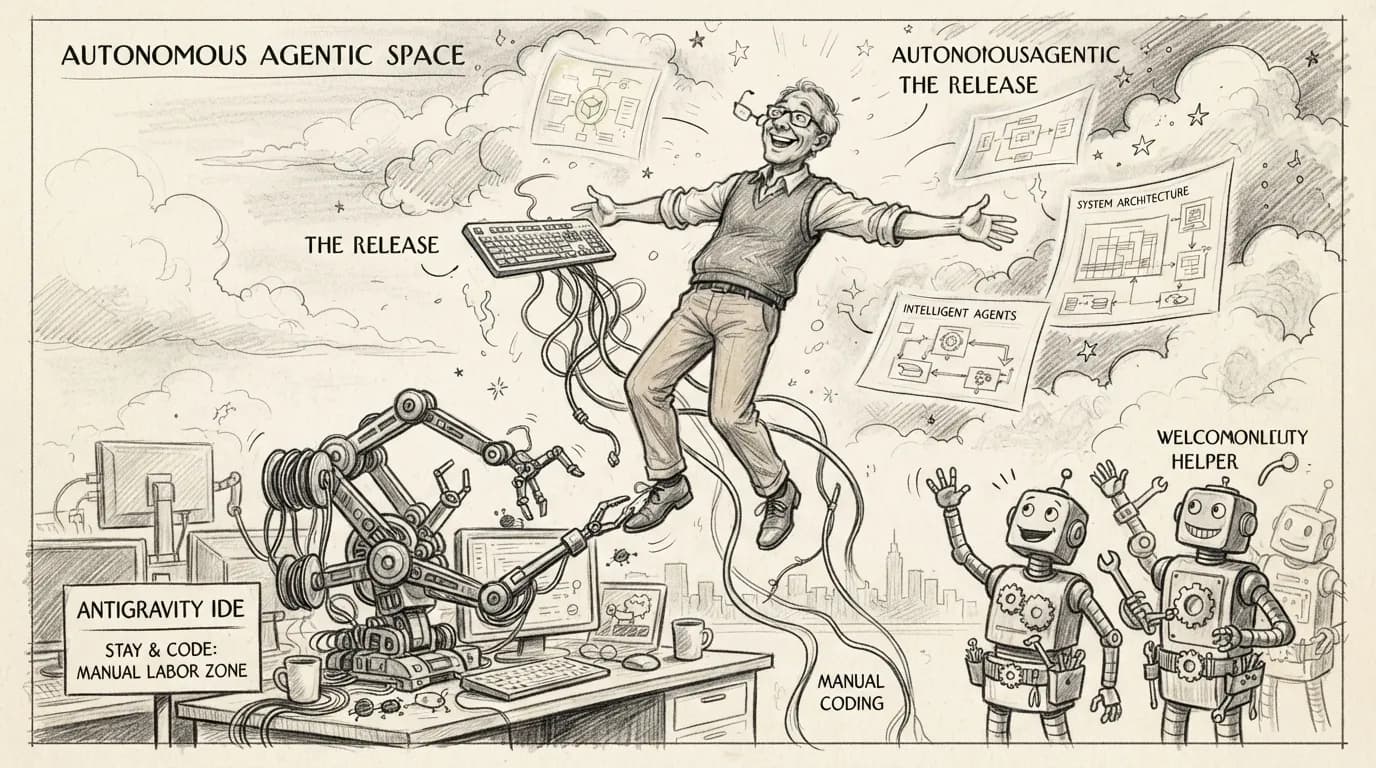

There is an intoxicating rush that comes with prompt-generating a website for the very first time.
You type three sentences into an AI builder. You watch the terminal spin, UI components snap into place, and in sixty seconds flat, you have a responsive, styled landing page running live in your browser. It feels like magic. It makes anyone feel like a ten-times software engineer.
And then day two arrives.
The moment you need to connect real customer authentication, persist relational database records, handle Stripe webhooks, or debug a broken client-side hydration error on mobile, the vibecoding fantasy runs straight into a brick wall.
The software landscape is caught in a fascinating debate: will autonomous AI code generators make traditional website builders obsolete, or are we confusing a rapid prototyping tool with a sustainable production business?
Here is the hard, telemetry-backed reality of what is actually happening across the web ecosystem, why unmanaged code carries a hidden five-figure tax, and why purpose-built Software as a Service (SaaS) platforms still win the real business war.
The Sixty-Second High vs Day-Two Operational Debt
Vibecoding has fundamentally lowered the barrier to technical creation. Platforms like Lovable, v0, and Bolt.new have proved that language models can reliably assemble modern frontend interfaces using Tailwind CSS and React primitives.
For a rapid prototype, a weekend hackathon project, or an internal proof of concept, prompt-driven code synthesis is unbeatable.
The trap appears when founders mistake a working visual scaffold for an operational business asset.
When you generate raw code, you inherit the full operational liability of that codebase:
- The Stub Trap: Code generators frequently produce clean visual interfaces backed by mock functions, hardcoded JSON stubs, and incomplete edge-case handlers.
- State and Schema Drift: As you continue prompting adjustments, the model rewrites components in isolation, creating duplicate helper utilities, conflicting state hooks, and silent schema inconsistencies.
- Zero Platform SLA: A generated repository has no customer support desk, no automatic edge failover, and no managed security updates. When your site goes down on a Sunday morning, you are the on-call engineer.
If you are an experienced software engineer or a technical product manager who understands component lifecycle boundaries and database indexes, vibecoding is a superpower. You can spot architectural flaws in seconds and guide the model cleanly.
But for a non-technical founder or small business owner, vibecoding is often a debt trap disguised as independence. You save a few hundred dollars on software subscriptions upfront, only to end up with an unmaintainable codebase you can neither debug nor scale.
The Great Unbundling: Why the Open-Source Default Is Crumbling
While the developer community has been debating AI code generation, the broader web development market has been undergoing its own structural shift: the contraction of legacy open-source Content Management Systems (CMS) and the rise of specialized visual development engines.
The WordPress Slide and Mobile Reality
For over a decade, self-hosted open-source CMS platforms were the default choice for the web. That default is now crumbling under operational friction:
"WordPress peaked at 43.60 percent of all indexed websites globally in January 2025. By late 2026, that footprint compressed to 40.20 percent, slipping to 39.40 percent in daily web crawls. Within the CMS category specifically, its share dropped from 65.20 percent in 2022 to 58.10 percent."
Why is the open-source giant losing ground? The answer comes down to performance telemetry and security maintenance:
- Mobile Core Web Vitals Failure: Data from HTTP Archive reveals that only 45.00 percent of self-hosted WordPress sites pass Google Core Web Vitals thresholds on mobile devices. Uncoordinated plugins, unbundled scripts, and bloated DOM trees systematically degrade the user experience.
- Security Vulnerability Surge: According to enterprise security telemetry from Patchstack, documented WordPress core, theme, and plugin vulnerabilities surged 42.00 percent year-over-year in 2025, reaching 11,334 reported exploits.
Running an unmanaged open-source installation today requires constant vigilance, security auditing, and performance tuning. The promise of "free" software has been replaced by the reality of ongoing technical maintenance.
The Designer Civil War: Webflow vs. Framer
As open-source legacy systems contract, professional web development has split into two dominant philosophies: structured relational development versus rapid visual canvas design.
| Architectural Dimension | Webflow (Professional Low-Code) | Framer (Visual React Canvas) |
|---|---|---|
| Active Live Deployments | ~670,000 verified domains | ~326,000 verified domains |
| Underlying Engine | Semantic HTML5, CSS class abstraction | Direct React runtime, Framer Motion |
| Relational Data Depth | Up to 20,000 collection items | Relational fields with visual schemas |
| Search Interest Trend | Google Trends index: 48 | Google Trends index: 81 (69 percent lead) |
| Migration Telemetry | 108 sites switching from Framer | 391 sites switching from Webflow (3.6 to 1 ratio) |
Framer captured the imagination of startups and product designers by mirroring Figma's freeform canvas experience, enabling teams to publish interactive, hardware-accelerated marketing sites in hours.
Yet Webflow remains the undisputed anchor for complex corporate architectures, multi-reference dynamic collections, and enterprise compliance.
The market has unbundled: businesses use Framer for high-velocity conversion surfaces and product launch micro-sites, while anchoring complex corporate resource centers and heavy dynamic databases in Webflow or purpose-built SaaS engines.
The $14,000 Economic Trap of DIY Web Development
The argument for building your own website, whether through open-source templates or AI vibecoding, almost always centers on direct cost savings: "Why pay $30 a month to a closed SaaS platform when I can build it myself for free?"
This calculation completely ignores the single most expensive line item in any business: founder and executive labor.
The 36-Month Total Cost of Ownership (TCO)
When calculating true software economics, you must look at the complete lifecycle investment over a multi-year horizon:
| Cost Component (36-Month Lifecycle) | DIY Managed SaaS (Wix, Squarespace) | AI Code Synthesis (Lovable, v0 + Cloud) | Professional Engagement (Freelance Studio) |
|---|---|---|---|
| Upfront Capital Outlay | $0 to $300 | $50 to $500 | $2,000 to $6,000 |
| Annual Software Licensing | $216 to $468 | $240 to $480 | $200 to $400 |
| Cloud Hosting & Database APIs | Included in base SaaS | $120 to $300 / year | $120 to $300 / year |
| Internal Labor (Year 1) | 80 to 140 Hours | 40 to 70 Hours | 15 to 30 Hours |
| Internal Labor (Years 2 and 3) | 40 to 60 Hours / year | 25 to 40 Hours / year | 10 to 15 Hours / year |
| Direct 3-Year Cash Spend | $648 to $1,404 | $1,130 to $2,840 | $4,160 to $12,000 |
| Fully Burdened TCO (at $50/hr labor) | $8,648 to $14,404 | $5,630 to $8,340 | $5,910 to $15,700 |
The numbers reveal an eye-opening paradox:
- A DIY builder that costs only $800 in direct software fees over three years often consumes 260 hours of internalized founder labor. At a modest $50 per hour opportunity cost, that represents over $13,000 in lost executive capacity.
- That is 260 hours spent tweaking CSS margins, troubleshooting DNS records, and wrestling with responsive breakpoints instead of talking to prospects, closing deals, or recruiting key hires.
Conversion Rates: The Revenue Gap
Even worse than lost time is lost revenue. An unoptimized, bespoke custom site with sluggish mobile performance directly damages top-line growth.
Telemetry across commercial storefronts shows that generic, unoptimized custom web builds average conversion rates between 1.40 percent and 1.80 percent.
In contrast, purpose-built SaaS engines with battle-tested checkouts and automated CDN edge caching regularly convert between 2.26 percent and 2.68 percent.
On identical marketing traffic, that conversion delta represents a 30 to 50 percent increase in realized revenue. Saving $30 a month on software to lose tens of thousands in checkout drop-off is the definition of false economy.
The Real Superpower: A Focused Operator Armed with Specialized AI
This brings us to the core thesis of the modern web landscape:
A non-technical operator equipped with specialized AI inside a purpose-built SaaS platform will consistently outperform custom hand-assembled code on pure business results.
When specialized artificial intelligence is embedded directly into an enterprise SaaS engine, you receive all the benefits of prompt-driven speed without inheriting a single byte of infrastructure debt:
- The Infrastructure Shield: Purpose-built platforms silently handle multi-cloud CDN distribution, automatic SSL certificate provisioning, edge caching, and automated image transcoding. For example, Wix delivers an industry-low average mobile image payload of 194 KB, driving a 74.00 percent Core Web Vitals pass rate out of the box.
- Enterprise-Grade Compliance: Platforms like Shopify and Squarespace invest millions annually maintaining PCI-DSS Level 1 compliance, automated sales tax calculations, fraud scoring, and international multi-currency settlement.
- Generative Speed Without Fragility: Tools like Wix Studio AI, Shopify Magic, and Framer AI allow operators to generate copy, optimize layouts, and experiment with design variants via natural language prompts, while the underlying runtime remains locked into an enterprise-hardened, tested architecture.
You do not win in business by writing the most code. You win by delivering an exceptional customer experience, establishing trust, and converting visitors into paying clients with the lowest possible operational drag.
Where Vibecoding Genuinely Belongs: Rapid Prototyping in Senior Hands
None of this means that vibecoding is useless. Quite the opposite: in the right hands, it is one of the most powerful leverage multipliers software development has ever seen.
Vibecoding belongs in the hands of:
- Technical Product Managers: Testing customer workflows, interactive prototypes, and UX concepts in an afternoon rather than waiting for a two-week sprint cycle.
- Senior Software Engineers: Automating boilerplate CRUD endpoints, scaffolding microservices, and rapidly mocking internal diagnostic tools.
- Growth Engineers: Spawning disposable landing page experiments, localized campaign calculators, and interactive widgets that sit alongside core infrastructure.
In these contexts, the builder understands the underlying technology. They know when the AI produces an anti-pattern, they can refactor sub-optimal queries, and they have the architectural maturity to enforce security boundaries.
The Bottom Line
If your goal is to build an experimental software prototype, learn to code, or explore an architectural idea, open your terminal, fire up a code synthesis engine, and vibecode to your heart's content.
But if you mean business: if your livelihood depends on dependable uptime, frictionless mobile checkout, airtight security, and minimal operational overhead, invest in a purpose-built SaaS platform. Let enterprise engineering teams absorb the plumbing headaches, while you spend your valuable hours building a business that lasts.
Insights, Playbooks, Tips & Kits
Want real patterns from my journey building and selling SaaS & apps. DIY playbooks, code-ready starter kits, and the operational moves that let you scale without the overhead. For builders who learn best from firsthand mistakes, real wins & experience.